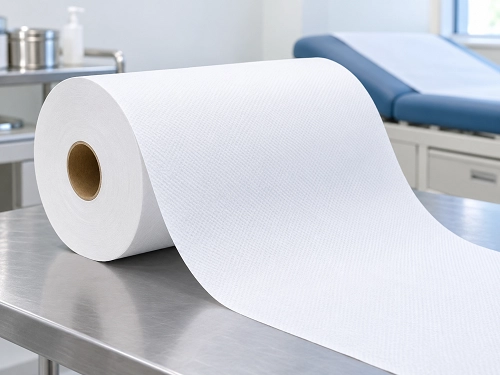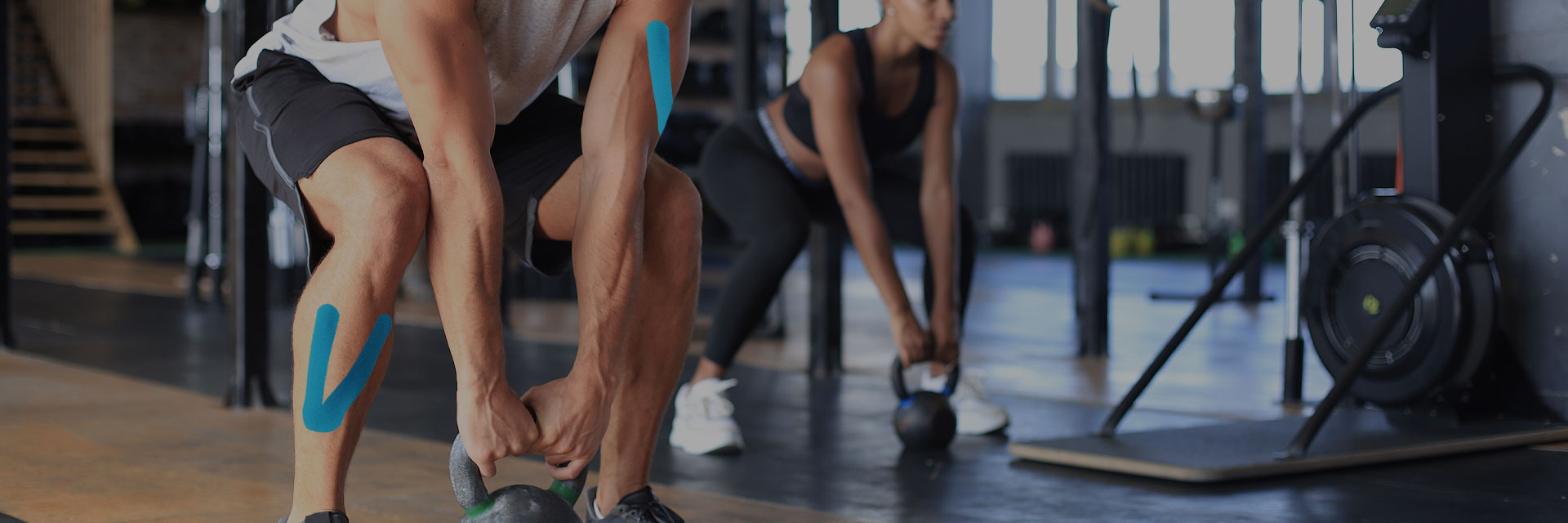
Ask three suppliers for a “medical jumbo roll” and you will get three different products. There is no universal grade, no single industry datasheet, and no shared definition of “standard adhesion.” A jumbo roll is the wide master roll of coated material that is later slit, die-cut and packaged into tapes, dressings, patches and electrode pads. Because it is a raw material rather than a finished product, almost every parameter that matters is negotiated between buyer and manufacturer.
What a medical jumbo roll is made of
Every jumbo roll has three layers of decisions. The carrier is the substrate: elastic fabric, rigid fabric, polyurethane film, foam or non-woven. The adhesive is a pressure-sensitive coating, applied across the full surface or in a pattern. The release liner protects the adhesive until the finished product is applied.
FULUO’s technical guide gives typical master widths of 300 to 1,500 mm and roll diameters of 300 to 800 mm. Scale is the reason quality matters here: one roll can yield thousands of finished products, so a small coating or slitting error is multiplied across every unit cut from it.
Six roll families, six different jobs
The carrier determines how the finished product moves with the body. The figures below are the typical ranges FULUO publishes. Treat them as starting points, because the final numbers should come from the datasheet of the exact grade you intend to buy.
Table 1. Jumbo roll families and typical characteristics
| Roll family | Carrier | Typical elongation | Typical adhesive | Typical end products |
|---|---|---|---|---|
| Kinesiology tape jumbo rolls | Elastic fabric (cotton, synthetic or nylon with spandex) | 130–180% | Acrylic, wave pattern | Sports and rehabilitation tape, wearable patches |
| Rigid sports tape jumbo rolls | Cotton or rayon rigid fabric | Under 10% | Zinc oxide or acrylic mass | Joint strapping and immobilization |
| Elastic adhesive fabric rolls | Woven elastic fabric | 50–100% | Natural rubber or acrylic | Elastic adhesive bandages, compression wraps |
| PU film adhesive rolls | Polyurethane film, about 15–50 µm | 500–700% | Acrylic, solvent or hot-melt | Film dressings, IV fixation, waterproof covers |
| Non-woven adhesive rolls | Spunbond or meltblown PP, or viscose | 15–30% | Acrylic emulsion | Medical plasters, surgical dressings |
| PE foam electrode rolls | Closed-cell PE foam | 20–40% | Conductive acrylic | ECG and TENS electrode attachment |
Source: FULUO Medical, Medical Adhesive Jumbo Rolls: The Complete Technical & Sourcing Guide (June 25, 2026), and the kinesiology tape jumbo roll product page for carrier options.
Why “standard” does not exist, and what to write instead
When a purchase order says only “kinesiology tape jumbo roll, 500 mm,” the supplier fills in the blanks. That works until a second batch behaves differently, or a second supplier is added. The remedy is a written specification that names each variable. FULUO’s own kinesiology roll page, for example, lists selectable options for carrier, adhesive type, adhesion level, liner, core size and wave pattern. Each of those is a decision you should record rather than leave to default.
Table 2. A practical specification sheet for a medical jumbo roll
| Parameter | What to define | Why it matters | Reference point (FULUO published) |
|---|---|---|---|
| Carrier | Material, construction, elongation and recovery | Sets stretch, breathability and how the product moves with skin | Kinesiology options include cotton, synthetic or nylon blended with spandex |
| Adhesive chemistry and adhesion level | Acrylic, zinc oxide, rubber or silicone; standard, aggressive or latex-free | Balances hold against skin trauma on removal | Typical peel: silicone 0.5–2, acrylic 2–10, zinc oxide 8–18 N/25 mm |
| Coat weight and tolerance | Target g/m², pattern (wave, dot or full coat), allowed deviation | Too little lifts early; too much macerates skin and hurts on removal | Mean within ±8% of target, no single sample beyond ±12% |
| Film thickness (if film) | Nominal thickness and uniformity | Uneven film produces uneven adhesive coating | About ±1 µm for PU film |
| Release liner | Type, release force, printing | Liner that is too tight tears; too loose slips during die-cutting | Grid paper listed for kinesiology rolls |
| Roll format | Width, length, diameter, core size | Must fit your unwind shaft and line speed | 300–1,500 mm wide; 300–800 mm diameter; 3-inch paper core on kinesiology rolls |
| Slitting and rewind quality | Edge condition, roll hardness, no adhesive ooze | Governs unwind behavior and cleanliness on your own line | Rewind tension controls roll hardness |
| Documentation | Certificate of analysis, biocompatibility data, shelf life, change-notification terms | Needed for your own technical file and audits | Ask for it per grade, not per product family |
One column deserves a caution. The peel values above are typical ranges for each adhesive class, and peel depends heavily on the test method, dwell time and test surface. When you write a peel requirement into a specification, name the method (for example ASTM D3330 or PSTC-101), the substrate and the dwell time. Otherwise two laboratories can report different numbers for the same roll and both be correct.
The adhesive decides skin safety
The backing sets how the product moves. The adhesive sets whether it stays on and whether removal hurts. A 2013 consensus paper in the Journal of Wound, Ostomy and Continence Nursing by McNichol and colleagues describes medical adhesive-related skin injury (MARSI) as prevalent yet under-recognized, with an estimated 1.5 million or more patients affected annually in the United States. Its practical message for product designers is that skin tension, joint movement and wear time should shape adhesive selection, and that application and removal technique matter as much as the product.
In practice this gives a simple ladder. For fragile or pediatric skin, silicone or low-peel acrylic emulsion is the usual starting point. For everyday dressings and fixation, acrylic on non-woven or PU film is common. For athletic strapping where hold is the priority, zinc oxide or higher-tack acrylic can be justified, ideally with clear removal instructions in the finished pack. FULUO publishes sweat-resistance guidance for sports rolls and gentler-adhesive guidance for home-care rolls on its sports and personal care application pages.
What goes wrong, and where it starts
The FDA’s total product life cycle database for adhesive tape and bandage devices (product code KGX) is a useful reality check. Among the specific device problems listed in adverse-event reports, “loss of or failure to bond” appears far more often than “adhesive too strong.” These are passive reports, so they show what gets reported rather than true incidence, but the direction is instructive: in this product category, adhesion that fails is a bigger reported problem than adhesion that is excessive.
For a buyer, the implication is practical rather than statistical. Premature lift-off is rarely just “weak glue.” Common upstream contributors include coat weight below target, uneven coating across the web, a carrier with a surface that the adhesive wets poorly, and storage that exposed the roll to heat or moisture. Each of these can be controlled at specification and incoming inspection, which is why Table 2 asks for tolerances rather than single values.
The converting line’s view of a good roll
A jumbo roll can pass every chemistry test and still run badly. Converters feel quality in four ways. Soft rolls telescope or shift during unwinding. Ragged slit edges leave adhesive residue that fouls blades and guide rollers. Inconsistent liner release causes tearing or slippage in die-cutting. Tension variation along the web shows up as wrinkles in the finished product. FULUO notes that slit-edge quality affects the clean-cut behavior of finished tape, and that rewind tension governs roll hardness and unwind ease.
A short incoming inspection catches most of this before it costs production time:
- Check the outer wrap for crushed edges or core damage.
- Match the label (lot, width, length, adhesive code) to your purchase order.
- Unwind the first meters and look for liner wrinkles, edge ooze and coating streaks.
- Run a peel test against your acceptance limits, using the same method every time.
- Store sealed, away from heat, direct sun and humidity, within the datasheet’s shelf-life and temperature limits.
Regulatory reality: who is responsible for what
A jumbo roll is a component or raw material, not usually the finished medical device. Responsibility for the finished device’s regulatory status sits with the company that places it on the market, and the roll supplier’s job is to provide clean, specific documentation. Three reference points are worth knowing:
- United States. Under 21 CFR 880.5240, medical adhesive tape and adhesive bandage is a Class I device subject to general controls and exempt from 510(k) premarket notification, subject to the limitations in 21 CFR 880.9. Exempt does not mean unregulated, so confirm your obligations with a regulatory adviser.
- Biocompatibility. Skin-contact materials are normally assessed under the ISO 10993 series, including cytotoxicity (ISO 10993-5), sensitization (ISO 10993-10) and irritation (ISO 10993-23). A report for one adhesive and carrier combination does not automatically transfer to another, so ask which exact build the report covers.
- Quality system. FULUO’s technical guide states that it holds ISO 13485 among its certifications. As with any supplier, request the certificate and check its scope and validity with the issuing body before relying on it.
This section is general information, not legal or regulatory advice. Requirements vary by market and by the intended use of your finished product.
A six-step qualification workflow
Because the product is non-standard, qualification is where risk is actually reduced. The sequence below is practical guidance rather than a regulatory requirement; adapt it to your product’s risk class.
- Write the end-use brief. Record wear time, how much the skin moves beneath the product, and who the wearer is (athlete, elderly patient, infant).
- Request the exact grade. Ask for the datasheet and a sample of the specific build, not a similar product from the same family.
- Bench-test against your specification. Typical tests are peel and shear adhesion, elongation and recovery (ISO 13934-1 for fabric tensile), moisture vapor transmission for films (for example EN 13726-2 or ASTM E96), and a coat-weight check.
- Run a line trial. Slit, die-cut and package a pilot quantity, watching unwind tension, edge ooze and liner behavior.
- Evaluate the finished construction on skin. Plan biocompatibility and wear testing for the finished build under your risk-management process.
- Lock the specification. Agree a change-notification clause with the supplier and keep a retained reference sample from the first approved lot, so later batches can be compared to something physical.
Working with FULUO on custom rolls
FULUO Medical has manufactured tapes in Zhejiang, China since 2007 and supplies both roll materials and finished products. According to its published information, the company operates three production lines, two independent laboratories, a 500 m² GMP 100,000-class workshop, more than ten full-time inspectors and roughly 4 million square meters of adhesive coating capacity per year, with 160 employees. Details are on its Why Choose Us page.
For non-standard requirements, the OEM and customization service covers material, adhesive, printing, backing paper and packaging. FULUO’s technical guide lists custom roll widths from 50 to 1,500 mm, adhesive coat weights and patterns, laminated substrate combinations, branded liner printing and several core diameters, with a published minimum of 500 kg for development quantities. Confirm current minimums and lead times directly, since they depend on the construction. If you also need finished goods, see the full product range.
For deeper reading on adjacent topics, FULUO’s blog covers selecting jumbo rolls by end use, the complete technical and sourcing guide, and medical tape raw material rolls.
Frequently asked questions
Is a jumbo roll the same as finished medical tape?
No. A jumbo roll is the wide master roll that is slit, die-cut and packaged into finished tapes, dressings or patches. The finished product is what the end user handles.
Why do two suppliers’ “standard” rolls perform differently?
Because no shared standard defines carrier, adhesive, coat weight or tolerances for a generic jumbo roll. Specifying those variables, and the test methods used to measure them, is the way to make comparisons meaningful.
Which adhesive is gentlest on sensitive skin?
Silicone adhesives are generally the gentlest on removal, followed by low-peel acrylic emulsions. Suitability still depends on the wearer, wear time and body site, so confirm with biocompatibility and wear data for your specific build.
Can I order custom widths, cores and liner printing?
Yes. FULUO accepts OEM specifications for width, core size, coat pattern, laminate structure and liner printing. Share your end-use brief and target specification when you inquire.